

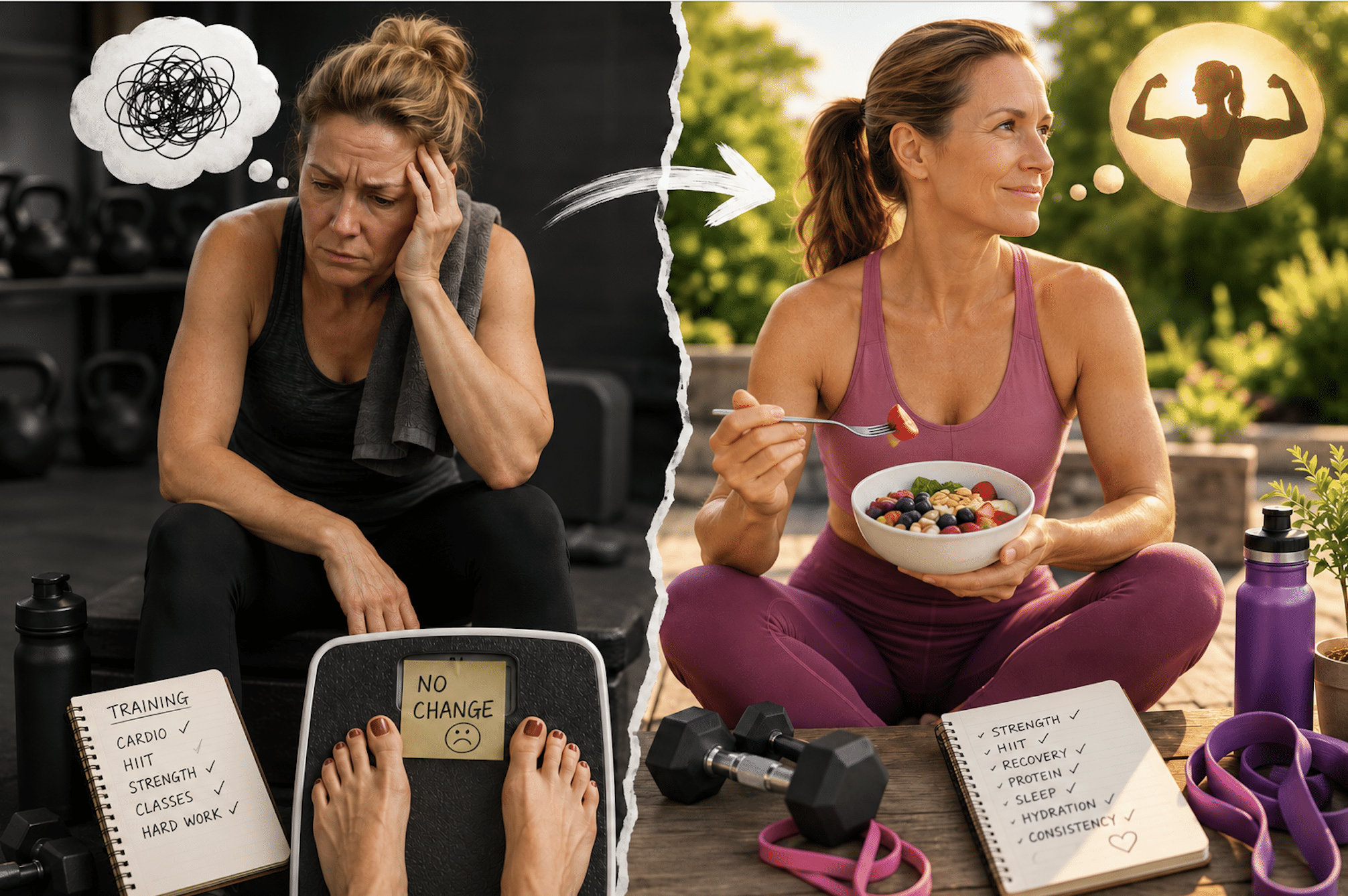
Have you been training hard, turning up consistently, eating “well”, doing your classes and pushing through your workouts — but still wondering why you are not getting the results you would like, specially after you hit certain age? Are you stuck, feeling burnt out, tired, or constantly sore after exercise?
It may be time to assess your training and fuelling plan, so you can understand what your body really needs and move forward safely and effectively.
For decades, many training and nutrition protocols given to women were based largely on male physiology. But women are not small men. Women’s bodies respond differently to fasting, stress, exercise intensity, protein timing, recovery, hormones and ageing.
Based on Dr Stacy Sims work— here is what you need to understand, and how to start finding out why your current approach may not be working for you.
1. Fasting and workout:
May Work for Some People, But for Active Women It Can Disrupt Hormone Signals Quickly.
When women fast or train without enough fuel, the brain can read this as a stress signal. The hypothalamus — a small control centre in the brain — helps regulate appetite, thyroid function, reproductive hormones, stress response and energy balance.
If the body senses that there is not enough energy available, it may start protecting itself by slowing down important hormone signals. This can affect thyroid function, recovery, training quality, menstrual cycle regularity, mood, sleep and how well your body adapts to exercise.
Research on low energy availability in women has shown measurable changes in thyroid hormones and luteinising hormone signals after only a few days of under-fuelling combined with training.
This is why repeated fasted training, especially when combined with intense exercise, low calories diet or midlife hormonal changes, may work against many women rather than helping them.
What may work better:
- Eat within 30 to 60 minutes of waking, especially if you train early
- Have at least 15g of protein before strength training
- Have 15g of protein plus around 30g of carbohydrate before cardio or high-intensity training
- Remember, this is not a full meal — it is a signal to the brain that fuel is available
For women, especially active women, the body often needs to know that enough energy is available before it can train hard, recover well and adapt properly.
Fasted Training Does Not Always Mean More Fat Burning
This is the part the fitness industry often does not explain clearly.
Training fasted may increase the amount of fat used as fuel during the workout, but that does not automatically mean you will lose more body fat overall.
It is also more complicated than simply using stored body fat for energy. This process takes time. Before the body can efficiently access stored fat, it may sense that there is not enough readily available energy. In response, it may protect itself by slowing down, reducing training output and making recovery more difficult. Over time, this can increase the risk of losing lean muscle tissue — the very tissue women need to build and protect.
Plus, if you train fasted and then delay eating after your workout. You may feel like you are being disciplined, worked hard, but your body may experience it as stress. And actually, the result can be lower training quality, higher stress, poorer recovery, more cravings later, muscle loss and slower progress.
A small amount of protein at least 15g , 20 to 30, 60 minutes before training can make a big difference. and again, it does not need to be a full meal, but it gives the body a signal that fuel is available.
For many women, this simple change can improve energy, performance and recovery very quickly.
2. Women Have a 45-Minute Post-Training Window to Eat. Men Have Up to Three Hours.
This is one of the most important and least known sex differences in exercise science.
After exercise, women’s metabolisms return to baseline within 45 to 60 minutes. Men’s metabolisms can take up to three hours to return to baseline.
What this means practically:
- Women in reproductive years need around 35g of high-quality protein within 45 minutes of finishing training
- Perimenopausal and menopausal women may need 40g + because the muscle’s response to protein declines with age
- Men can often eat their post-training meal one to two hours later and still get the same adaptation
The idea that “there is no post-workout window” is mostly based on male data. For women, the window is real and it is tight.
If you miss it consistently, your training adaptation can be significantly reduced — even if the session itself was excellent.
This is why two women can train in the same way and get completely different results.
Timing changes the outcome.
3. Women Should Train Very Hard or Very Easy — Not Be Stuck in Between All the Time
Dr Stacy Sims often talks about polarised training: spending more time either, training very easy and training very hard, instead of always or most of the time in the moderate middle zone.
This does not mean moderate exercise is bad. Walking faster, cycling, dancing, steady cardio and group classes all have benefits. The problem begins when women, especially from their mid-30s onwards, do most of their training in that “moderately hard” zone — not easy enough to recover from properly, but not hard enough to create the strong strength, power or fitness adaptation they need.
This can leave you feeling tired, sweaty and like you worked hard, but still not getting the results you want. For some women, too much moderate-intensity training, combined with poor fuelling, poor sleep and not enough recovery, may contribute to higher stress hormones level all the time, stalled progress, cravings, disrupted sleep, burnt out feeling, sore body all the time and stubborn belly fat.
What may work better is a more balanced structure.
Very high intensity:
True sprint interval training — 30 seconds or less at very hard effort, followed by 2 to 3 minutes of full recovery, for up to 5 rounds.
Or HIIT: 1 to 4 minutes at 80% effort or more, with proper recovery.
Very low intensity:
Walking, light movement, mobility, balance, recovery breathing and time in nature.
Many popular group fitness classes, such as 1 hr long high-energy circuits, spin classes and similar workouts, can keep women in the moderate zone for too long. They can be fun and motivating and are great workout, BUT, if they are your main training style all the time, they may not give your body the strength, power, recovery and hormonal support it needs.
Also very important is to make sure you did sprint in high intensity and not sprint in between zone.
The goal is not to destroy yourself.
The goal is to train with purpose: easy when it should be easy, hard when it should be hard, and recovered enough to adapt.This does not mean every session should be brutal.
4. From Your Mid-30s, Lifting Heavier Is More Important Than Lifting More
In your 20s and early 30s, training to failure can work well. Higher reps and hypertrophy-focused work can drive strength and muscle growth effectively because oestrogen supports recovery and adaptation.
From your mid-30s onwards, oestrogen begins to fluctuate. The same approach may stop working. The body needs a different type of stress.
What Dr Stacy Sims recommends for women 35 and above is power-based training.
That means:
- 4 to 6 reps per set, plus 2 reps in reserve — meaning you could do 2 more in perfect form before failure
- Heavier loads than most women are currently using
- Compound movements for example as squats, deadlifts?alternative to it, overhead press and rows
The key is this: when you are older, you need heavier loads to create the central nervous system response that oestrogen used to create automatically.
Lighter weights with higher reps can create metabolic stress, but not necessarily the strength and power adaptations women need for longevity.
Bone density.
Balance.
Cognitive protection.
Independence at 80 and 90.
It all starts here.
5. Perimenopause Can Start at 35 — and Your Body Will Tell You Before Any Doctor Does
Perimenopause does not suddenly begin at 50. For some women, changes can start in the mid-30s or early 40s.
The body often gives signals before blood tests or medical appointments confirm anything.
The signals Dr Stacy Sims describes include:
- Training is not producing results despite consistent effort
- Body composition is changing with no change in diet or exercise
- Sleep is disrupted — taking longer to fall asleep, lighter sleep or waking more often
- Frozen shoulder or plantar fasciitis appearing — both are strongly associated with oestrogen fluctuation
- More aches, stiffness and poorer recovery
Men age in a relatively linear fashion. Women often have a more defined inflection point in their mid to late 40s, when multiple systems are affected at the same time because every system in the body responds to oestrogen.
The typical response may be an antidepressant or a cortisol explanation. Dr Stacy Sims says this may not address the full picture.
The better response may be:
- Shift immediately to power-based heavy lifting
- Replace moderate-intensity cardio with true sprint intervals
- Increase protein intake to at least 1 gram per pound of body weight and more on the day you strength train
- Fuel before and after training
- Protect sleep and recovery
The intervention window matters. The earlier you start, the better the outcome.
6. Creatine Is Not Just for Your Muscles
Most women avoid creatine because they think it will make them bulky and it is for men. The research says something entirely different.
Creatine is not just a muscle supplement. It also supports brain energy.
Your brain uses around 20% of the body’s total energy, and creatine helps replenish ATP — the body’s energy currency. Here I must mention, Functional breathing is power house too, because better functional breathing create even more ATP, supports oxygen delivery, nervous system balance and energy production. but about breathing we would talk in another article.
What creatine may support for women:
- Brain energy
- Bone health (help to maintain structure not building it and must be with strength straining exercise)
- Muscle mass
- Help better functioning after sleep deprivation and stressful times (it doesn't cure or fix main issue it just give extra support)
- Gut integrity during exercise
Creatine may also help support gut integrity by supporting the mucosal lining of the intestines, which is important because many women experience gut distress during exercise.
Dosing note: the label may tell you to take multiple doses because it is often written for bodybuilding athletes loading for muscle performance. That is a different application.
3 to 5g pure creatine monohydrate once per day. No loading phase. No cycling phase. Just take it consistently. This is general advice for muscle support, but it could be more. It depends on what you are targeting and another factors, so based on newest research, you may increase dosage.
See interview with Dr.Darren Candow's explaining everything you need to know about creatine. Link is in commence.
Choose creatine monohydrate from a reputable source, as the quality of the raw material can vary significantly by brand.
Concerns about hair loss from creatine are not supported by strong evidence. Hair changes women experience in their 40s are more likely connected with hormonal changes, not creatine.
As always, check with a healthcare professional first if you have kidney disease, medical concerns or take medication.
Creatine does not make women bulky. Heavy lifting does not make women bulky either. What they both do is support strength, function and resilience.
7. Your Breathing During and After Exercise Matters
How you breathe during and after exercise affects your stress response, energy, performance and recovery. (There is more to it and depends from many factors, if interested ask in comments)
If you become breathless very quickly, breathe through your mouth often, even in nonactive state, hyperventilating / over breathing or struggle to calm down after exercise, means your body may stay in a higher stress state for longer or all the time.
During exercise, aim to breathe as calmly and efficiently as possible, using nasal breathing when appropriate, especially during warm-up, recovery periods and lower-intensity work. In high intensity work you breathe through the mouth but after exercise, do not just stop and rush away. Take a few minutes to bring your body back down: slow your breathing, breathe through your nose, lengthen your exhale and allow your heart rate to settle. Reset it to light, slow and diaphramatic breathing.
This helps shift the body out of “fight or flight” mode, supports recovery and helps calm stress hormones such as cortisol.
Questions to Ask Yourself
If you have been training hard but are not seeing the results you should ask yourself:
Am I training too often in the moderate zone?
Am I under-fuelling before exercise?
Am I missing protein after training?
Am I lifting heavy enough?
Am I recovering properly?
Am I sleeping well?
Am I adjusting my training for perimenopause, menopause, post-menopause and my age?
Am I doing enough true strength and power work?
Am I eating enough protein across the day?
How is my breathing?
Am I out of breath quickly, or do I often breathe through my mouth during exercise?
Do I calm my body and breathing properly after exercise?
Sometimes the answer is not more exercise.
Sometimes the answer is better timing, better fuelling, better recovery, better breathing and better training structure.
At Fit2Shine, this is why we focus on strength, protein, hydration, functional breathing, sleep, recovery, mobility, balance, sprint intervals, functional movement and long-term health.
The goal is not just to look different.
The goal is to feel strong, sleep better, protect your bones, support your brain, improve your energy, maintain your independence and build a body that carries you well into your 70s, 80s and beyond.
Do you need some help?
Stop guessing and start training with a plan that actually fits your body, your age and your goals.
As a Fit2Shine member, you receive one free health and fitness assessment every year — a chance to check where you are, what may be holding you back, and what your body needs next.
Not a member? You can still book a 1-1 Health & Fitness Assessment and receive a clear, personalised plan to help you move forward with more confidence, better direction and less wasted effort. How to book? Please go to Personal Training, and at the end of the page book your consultation with Ivana or email us on fit2shineuk@gmail.com
Train smarter. Fuel better. Recover properly. Get the support your body deserves.
Here is the official Diary of a CEO interview with Steven Bartlett and Dr Darren Candow, explaining everything you need to know about creatine.
You can also find Dr Candow’s published work and many of his research papers, but this interview is especially useful because it covers a wide range of topics in a clear and easy-to-understand way, even for a non-scientific audience.
:https://youtu.be/Jk7RAkFN4vk?si=OYUwCMA1yT4QEpEa